Sponsored & UGC Link Attributes: The 2019 Update Explained
AI Summary
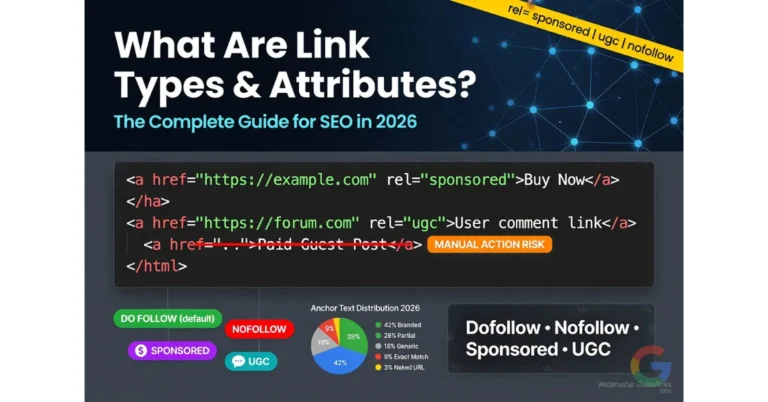
What are sponsored and UGC link attributes? Link attributes are HTML rel values that tell search engines how to interpret each link on a page. The four that matter for SEO are dofollow (the unmarked default that passes link equity), nofollow (introduced in 2005 to signal links that should not pass equity), sponsored (introduced in 2019 to identify paid links), and UGC (introduced in 2019 to identify links from user-generated content like comments and forums). Together they form the signaling system site owners use to disclose the nature of each link to Google.
What this article covers and who it is for: This article covers why link attributes exist, how each attribute type works, what changed when Google introduced sponsored and UGC in 2019, how anchor text and link context interact with attributes, how Google uses attributes in its ranking systems in 2026, the most common implementation mistakes, and practical guidance for operators. It is for SEO practitioners, content managers, and site owners who need to understand how link attributes affect rankings, manual actions, and the broader trust signals Google evaluates.
The rule: Link attributes are not optional metadata. They are how the web stays honest about commercial relationships. Failing to mark paid links as sponsored is one of the most common Webmaster Guidelines violations and a direct trigger for manual action. The attributes tell Google what each link means, and getting them right is a baseline requirement, not an optimization.
Why Link Attributes Exist
Every link on the web carries information beyond the URL it points to. The HTML anchor tag includes optional attributes that tell browsers and search engines how to interpret the link. The two attributes that matter most for SEO are rel and the anchor text the link wraps, and the values those carry shape how Google’s systems evaluate the link’s role in the broader trust graph of the web.
The framework as it operates in 2026 has four primary rel values that affect SEO. The implicit default, which has no rel attribute and is treated as a standard followed link. The explicit nofollow value, introduced in 2005 to combat blog comment spam. The sponsored and ugc values, both introduced in September 2019 to give site owners more granular control over how Google interprets paid links and user-generated content.
The reason the framework exists is straightforward. The web’s link graph is the substrate Google has always used to evaluate page importance, going back to the original PageRank paper. As the web grew and link manipulation grew with it, Google needed mechanisms for site owners to signal which links represented genuine editorial endorsement and which links existed for other reasons. The attribute system is that signaling mechanism.
The shorthand version: link attributes are how site owners tell Google what each link means. Misusing the attributes, particularly failing to disclose paid links as sponsored, is one of the most common Webmaster Guidelines violations and a direct trigger for manual action. The attributes are not optional metadata. They are part of how the web stays honest about commercial relationships.
For the broader content production discipline that supports proper link attribution, the Content discipline covers the operational architecture, and the Credibility discipline covers the disclosure infrastructure that Trust signals depend on.
Dofollow: The Default Standard
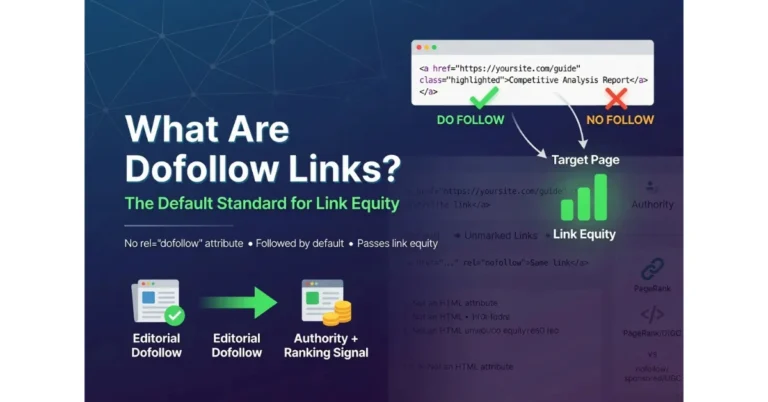
The term “dofollow” is technically a misnomer. There is no rel="dofollow" attribute in the HTML specification. A dofollow link is simply a link with no rel attribute on the categories Google uses to filter, which means the link is followed by default. The terminology emerged in the SEO community as the natural opposite of nofollow, and it has stuck despite not being a real attribute value.
What matters operationally is that an unmarked link passes link equity. Google’s systems treat the link as an editorial endorsement from the linking page to the linked page, and the linked page receives a portion of the linking page’s authority through the link. The amount of equity passed depends on many factors including the linking page’s own authority, the relevance of the linking page to the linked page, the position of the link within the page, the surrounding text context, and the overall pattern of links on the page.
The default-followed status of unmarked links is the foundation that the entire link-based ranking system rests on. It is also the configuration that creates most of the confusion around link attributes, because operators who do not understand the system assume that links need to be explicitly marked as dofollow to pass equity. The opposite is true. Unmarked links are followed automatically. Attributes only matter when the site owner wants to signal something other than the default.
The implication for link building is that the work of earning quality unmarked links from authoritative sites in the relevant topical neighborhood is the foundation of the link-based authority signal. Other attribute discussions are secondary to whether the underlying links exist in the first place, and exist for the right reasons.
For the deeper treatment of how dofollow links work, why they are the default standard, when they matter most, and how to evaluate the quality of dofollow links a site has earned, the tier article on Dofollow Links covers the full operational guide.
Nofollow: When Google Stops Following
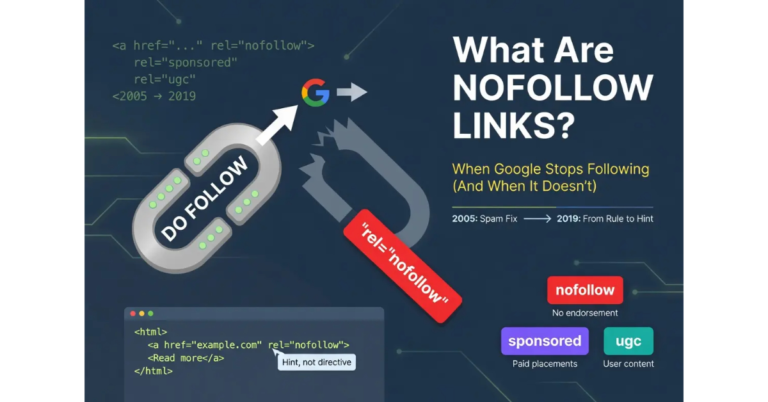
The nofollow attribute was introduced in 2005 as a binary directive. A link with rel="nofollow" told Google not to follow the link and not to pass equity through it. Blog comment sections were the original use case, because spammers were flooding comment sections with links to manipulative sites, and blog owners had no way to prevent those links from passing authority.
The 2019 update changed nofollow from a directive to a hint. Google’s systems now treat nofollow as a signal they may choose to consider rather than a rule they must follow. In practice, this means that nofollow links from high-authority editorial sites may still pass some value, because Google’s systems recognize that the editorial decision to link, even with nofollow, is itself meaningful context.
The contemporary use cases for nofollow include links the site cannot editorially vouch for, links to login pages or internal utility pages that do not need to receive equity, and as a fallback for paid links when sponsored is not used. The fallback use is explicitly endorsed in Google’s documentation, which states that nofollow is an acceptable alternative to sponsored for identifying paid relationships.
The nuance operators miss most often is the difference between nofollow as a link-level directive and nofollow as a page-level directive. The meta robots nofollow tag tells search engines not to follow any links on the page. The rel="nofollow" attribute on an individual link tells search engines not to follow that specific link. Using the page-level directive when you mean the link-level attribute, or vice versa, produces unintended consequences that can block equity flow across the site.
For the deeper treatment of nofollow links, how they differ from dofollow links, when they matter for SEO strategy, and how to evaluate whether nofollow links in your profile are helping or hurting, the tier article on Nofollow Links covers the full operational guide.
Sponsored and UGC: The 2019 Update
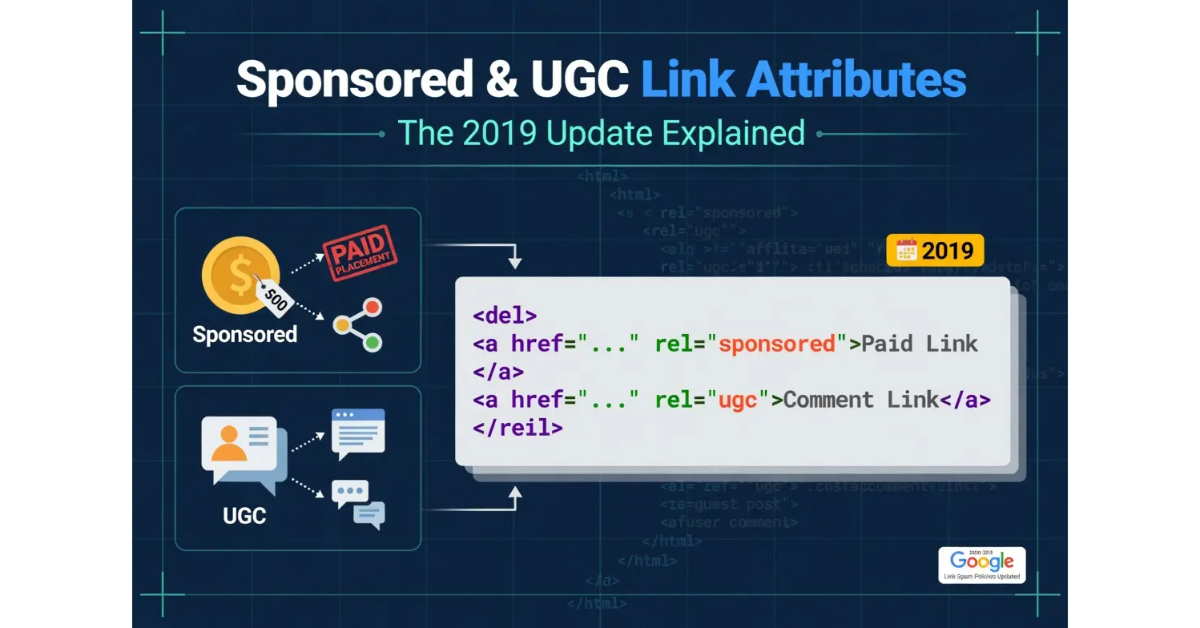
The September 2019 link attribute update introduced two new rel values alongside the reframing of nofollow. The rel="sponsored" attribute is for paid placements, including sponsored content, paid links, and affiliate relationships. The rel="ugc" attribute is for user-generated content, including blog comments, forum posts, and any content the site owner did not directly create or endorse.
The introduction of these attributes was Google’s response to the increasingly blurry line between editorial links and commercial links. The web had evolved from a place where most links were editorial decisions to a place where significant percentages of links were paid placements, affiliate recommendations, sponsored content, or user-generated content of varying quality. The single nofollow attribute was no longer granular enough to distinguish these cases, and the lack of distinction made it harder for Google’s systems to evaluate link patterns accurately.
The sponsored attribute is particularly important because Google’s link spam policies require paid links to be disclosed. Failing to mark paid placements as sponsored (or as nofollow as a fallback) is a direct violation of Webmaster Guidelines and one of the most common triggers for manual actions. The disclosure requirement applies to any link where money changes hands in connection with the link being placed, which includes sponsored content, paid guest posts, affiliate links in many contexts, and any link placement that involves compensation.
The UGC attribute serves a different purpose. It signals that the link was placed by a user rather than by the site owner, which gives Google’s systems context for evaluating the link without holding the site owner responsible for endorsing it. Forum operators, blog platforms, and any site with user-generated content should be using UGC on links in user content, both to comply with Webmaster Guidelines and to protect the site from being penalized for spam links users might place.
The attributes can be combined. A link can carry both rel="sponsored ugc" if it is both a paid placement and user-generated, and the combination signals exactly what the link is to Google’s systems.
For the deeper treatment of when each attribute applies, the disclosure requirements for paid links, the implications for affiliate marketing, and the technical implementation patterns, the tier article on Sponsored and UGC Attributes covers the full operational guide.
Anchor Text and Link Context
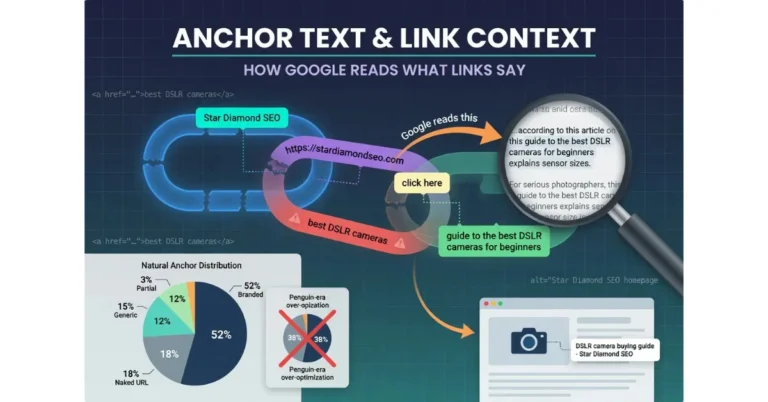
Anchor text is the visible, clickable text inside the link. The HTML structure wraps text in an anchor tag, and that text is what users see and what Google’s systems read as the description of what the linked page is about. The relationship between anchor text and the linked page is one of the strongest signals in the link evaluation system, because the anchor represents what the linking site believes the linked page is about.
The framework recognizes several anchor text categories. Exact match anchors use the exact target keyword as the anchor text. Partial match anchors include the target keyword along with other words. Branded anchors use the linked site’s brand name. Generic anchors use phrases like “click here” or “read more” that say nothing specific about the linked page. Naked URL anchors use the URL itself as the visible text. Each category sends different signals, and the natural distribution across a site’s inbound link profile shapes how Google evaluates the link pattern.
The over-optimization penalty is the most common anchor text failure. Sites that have built link profiles with too high a percentage of exact match anchor text trigger algorithmic flags because organic link building does not produce that pattern. Real editorial links overwhelmingly use branded anchors, naked URLs, or generic descriptions of the destination. A site whose inbound profile shows fifteen percent or more exact match anchors is signaling either deliberate manipulation or an unusual situation that warrants closer inspection.
The link context, meaning the surrounding text that frames the link, also matters. Google’s systems read the paragraph the link sits in as additional information about what the link is about. A link to a page about car audio embedded in a paragraph about home improvement signals confusion to the systems. The same link embedded in a paragraph about subwoofer installation reinforces topical relevance. The same principle applies to internal linking, where the surrounding context of each link between your own pages helps Google understand the topical relationships across your site. Quality SEO writing naturally produces link contexts that reinforce topical relevance because the links are placed where they genuinely serve the reader rather than where they mechanically hit a keyword target.
For the deeper treatment of anchor text categories, natural distribution patterns, over-optimization penalties, and the surrounding text context that Google uses to evaluate link relevance, the tier article on Anchor Text and Link Context covers the full operational guide.
h2 id=”how-google-uses”>How Google Uses Attributes in 2026
The framework as Google’s systems use it in 2026 is more sophisticated than the binary follow/nofollow split that operated in earlier eras. The attributes provide hints that the systems combine with many other signals to evaluate each link, and the evaluation produces a more nuanced output than simple equity passing or filtering.
The first thing the systems do is read the attributes. An unmarked link is followed by default. A nofollow link is treated as a hint that the linking site does not endorse the destination, and the systems consider the hint alongside other context. A sponsored link is recognized as a paid placement and evaluated through that frame. A UGC link is recognized as user-generated and evaluated with appropriate skepticism about whether the linking site stands behind the destination.
The second thing the systems do is read the link in the context of the surrounding page and the broader site. A nofollow link from an authoritative editorial site might still pass some value because the systems recognize that the editorial decision to link, even with nofollow, is itself a form of endorsement. A dofollow link from a low-quality site might pass less value than its surface metrics suggest because the systems recognize the site’s overall pattern is not editorial.
The third thing the systems do is evaluate the link in the context of the linked site’s overall profile. A site with a healthy mix of dofollow editorial links, branded anchor text distribution, and natural growth pattern is treated differently than a site whose link profile shows the engineered patterns of manipulation. The same individual link might count differently depending on which profile it sits within. The helpful content framework applies a similar principle from the content side: the overall pattern of quality across the site affects how individual signals are evaluated, and a site that demonstrates genuine value in its content produces a context where its link signals are treated with more confidence.
The implication for operators is that link attributes are inputs to a complex evaluation, not switches that flip ranking outcomes directly. The work that scales is building genuine editorial relationships that produce links with appropriate attributes, rather than trying to game any single attribute or pattern. The systems have grown more capable of identifying gaming over time, and the gap between what looks like authority in third-party tools and what actually translates to ranking benefit has widened every year. The crawlability layer matters here too: if Google cannot efficiently crawl and process the pages receiving links, the link equity those pages earn cannot flow through the site’s crawl budget to the rest of the content.
The Common Attribute Mistakes
The most common mistakes operators make with link attributes are predictable. They show up across new sites learning the system, established sites that have grown careless about disclosure, and affiliate sites that have grown commercial without updating their attribution practices.
The first common mistake is the missing sponsored attribute on paid links. Sites accept payment for content placement, sponsored articles, or affiliate placements and fail to mark the resulting links as sponsored. The pattern is the most common Webmaster Guidelines violation in the link space, and Google’s systems have grown more capable of detecting paid relationships through transactional patterns even when the disclosure is absent. The fix is operational. Every link where compensation is involved should carry rel=”sponsored” or at minimum rel=”nofollow”.
The second common mistake is the unmarked affiliate link. Affiliate marketing sites embed tracking links in content without marking them as sponsored. The links are commercial relationships by definition, and the lack of disclosure is a Webmaster Guidelines violation regardless of how the site characterizes the relationship internally. Affiliate networks vary in how they handle this, but the requirement applies regardless of network policy. The same disclosure standard that applies to paid links applies here, and the question of whether Google penalizes undisclosed commercial relationships is answered clearly in the guidelines: yes, when the pattern is detected.
The third common mistake is the over-broad nofollow. Sites apply nofollow to all external links as a defensive measure, including links to authoritative sources that genuinely support the content. The practice signals to Google’s systems that the site is not making editorial judgments about which sources it endorses, which weakens the site’s own credibility profile. The fix is to use nofollow only where it applies (paid, user-generated, or content the site cannot endorse) and to leave editorial citations as standard followed links.
The fourth common mistake is the misuse of UGC on editorial content. Sites apply UGC to links in their own content as if it were a softer version of nofollow, when UGC specifically signals user-generated content the site did not create. Misuse confuses the signal and may trigger investigation if the pattern is widespread. UGC should only appear on actual user-generated content like blog comments, forum posts, and similar.
The fifth common mistake is the over-optimization in anchor text distribution. Sites build link profiles with heavy exact match anchor text, often through guest posting campaigns or paid placements where the operator controls the anchor selection. The pattern is detectable algorithmically and triggers ranking suppression even when no manual action is issued. The fix is to use branded anchors, naked URLs, and natural variations across inbound links, with exact match limited to a small percentage of the overall profile.
Practical Implementation for Operators
The implementation of link attributes breaks into two operational areas. Outbound links the site publishes, and inbound links the site has earned or built.
For outbound links, the discipline is straightforward in principle and easy to slip on in practice. Every link the site publishes should carry the appropriate attribute for what the link is. Editorial citations to authoritative sources are unmarked (followed by default). Paid placements are marked sponsored. User-generated links in comment sections are marked UGC. Links the site is required to publish but does not endorse are marked nofollow. The operational challenge is consistency. Sites that get this right have editorial workflows that include attribute review as part of the publishing process. The on-page SEO checklist includes link attribute review as one of the items that should be verified before any page goes live.
For inbound links, the operator’s control is indirect. The linking site decides what attributes to use on the links pointing to the operator’s site. What the operator can control is the anchor text and context where they have any influence on placement. Guest posts the operator writes can use natural anchor text. Press releases can use branded anchors. Editorial relationships can be cultivated by writing pieces that journalists naturally want to cite, which produces editorial links with editorial attributes the operator did not have to negotiate.
The audit pattern is the same for both directions. Periodically review outbound links for proper attribution, particularly on older content where standards may have evolved since publication. Periodically review inbound link profile for anchor text distribution and attribute distribution, particularly looking for patterns that suggest manipulation has occurred. Both audits identify gaps that the strategic work can then address. The calibration discipline provides the measurement framework for running these audits on a schedule and tracking whether the fixes are producing the expected improvements in profile health.
For sites building a dedicated link building program, proper attribute discipline is foundational. The links you build need to carry the right attributes from day one, because retroactively fixing attribute violations across third-party sites is operationally difficult and sometimes impossible. Maintaining a consistent publishing cadence that includes regular link profile audits prevents attribute debt from accumulating silently.
For sites that want a structured starting point on the broader off-site SEO discipline that supports proper link attribution, the Credibility discipline covers the operational architecture. The E-E-A-T framework ties the link attribution discipline to the broader quality signals Google evaluates, because proper disclosure is one of the most direct Trust signals a site can provide.
Verdict
Link types and attributes are the technical layer that determines how Google interprets every link on the web. The framework includes the implicit dofollow default, the explicit nofollow value introduced in 2005, the sponsored and UGC attributes introduced in 2019, and the anchor text dimension that signals what the link is about. The four together shape how the link-based authority system operates, and misunderstanding any of them produces predictable failure modes.
Trust is the foundation Google has named the most important factor in the broader quality framework, and proper link attribution is one of the most direct Trust signals a site can provide. Sites that disclose paid placements correctly, mark user-generated content appropriately, and avoid over-optimized anchor text distributions produce profiles that the framework recognizes as legitimate. Sites that fail at attribution accumulate signals that look like manipulation regardless of intent.
The 2026 reality is that the systems have grown more capable of detecting attribute violations and engineered patterns than they were when the framework was introduced. Operators who treated attribute compliance as optional through earlier eras are increasingly being identified by the systems through transactional pattern detection, anchor text analysis, and inbound profile evaluation. The gap between sites that follow attribution discipline and sites that do not has widened every year as the proxies have improved. The same link evaluation logic that powers organic rankings now influences which sources AI platforms consider trustworthy enough to cite in generated responses, making proper attribution even more consequential than when it only affected traditional search.
The practical sequence for operators is straightforward. Build outbound link discipline that marks paid links sponsored, user-generated content as UGC, and editorial citations as standard followed links. Audit inbound link profile periodically for anchor text distribution and pattern naturalness. Treat attributes as part of the editorial workflow rather than as an afterthought.
The deeper treatment of each attribute lives in the four sibling articles. The article on Dofollow Links covers the default standard and the foundation of link-based authority. The article on Nofollow Links covers the 2005 introduction and the 2019 reframing as a hint. The article on Sponsored and UGC Attributes covers the 2019 update and the disclosure requirements for paid links. The article on Anchor Text and Link Context covers the visible link text and the surrounding context that Google uses to evaluate link relevance.
FAQ
What is the difference between nofollow, sponsored, and UGC link attributes?
Nofollow is a general signal that the linking site does not endorse the destination. Sponsored specifically identifies paid placements including sponsored content, paid links, and affiliate relationships. UGC identifies links placed by users rather than by the site owner, such as blog comments and forum posts. All three tell Google that the link is not a standard editorial endorsement, but each provides different context about why. Sponsored and UGC were introduced in 2019 to give site owners more granular control than the single nofollow attribute provided.
Do I need to mark affiliate links as sponsored?
Yes. Affiliate links are commercial relationships by definition, and Google’s link spam policies require paid links to be disclosed. The links should carry rel=”sponsored” or at minimum rel=”nofollow” as a fallback. The requirement applies regardless of how your affiliate network handles disclosure on their end. Failing to mark affiliate links is one of the most common Webmaster Guidelines violations and can trigger manual action if the pattern is detected.
Does a nofollow link pass any SEO value?
Since 2019, Google treats nofollow as a hint rather than a directive. This means nofollow links from high-authority editorial sites may still pass some value, because Google’s systems recognize that the editorial decision to link is itself meaningful context even when nofollow is applied. However, the value passed is generally less than an equivalent unmarked dofollow link. A natural link profile contains a mix of both, and having nofollow links is expected and healthy.
Should I nofollow all external links on my site?
No. Applying nofollow to all external links signals to Google that the site is not making editorial judgments about which sources it endorses, which weakens the site’s own credibility profile. Use nofollow only where it applies: paid links, user-generated content, or destinations the site cannot editorially vouch for. Leave editorial citations to authoritative sources as standard unmarked links. The selective use of attributes is what demonstrates editorial judgment.
What happens if I use the wrong link attribute?
The consequences depend on which mistake is made. Failing to mark paid links as sponsored is a direct Webmaster Guidelines violation that can trigger manual action. Using UGC on editorial content confuses the signal about who created the content. Over-applying nofollow weakens your credibility profile without triggering penalties. Over-optimizing anchor text across your link profile triggers algorithmic ranking suppression. The most serious consequence is the missing sponsored attribute on paid links, because that is the violation Google has been most explicit about enforcing.