
Content: The Fuel That Powers Everything Else
You cannot rank what you do not write. Content is the raw material of every other discipline in the 5C Framework. Without it, there is nothing to optimize, nothing to crawl, nothing for other sites to link to, and nothing for AI platforms to cite when someone asks a question your business should be answering.
Most content produced in 2026 fails. Not because the topics are wrong or the keywords are missing, but because the content itself has no substance behind it. It reads like a summary of other summaries. It covers the surface of a topic without ever demonstrating that the writer has done the work, tested the approach, or experienced the outcome. Google’s quality systems are designed to identify exactly that pattern and bury it. The sites that rank and hold their positions are the ones publishing content that a knowledgeable human would recognize as genuinely useful, not content that a keyword tool would score as optimized.
Star Diamond SEO builds content the way operators build content for their own sites. Not for a client brief. Not from a template. From actual expertise applied to a specific topic with the intent of producing the most useful page on the internet for that query. That is the standard. Everything on this page describes how we meet it.
Why Content-First Wins
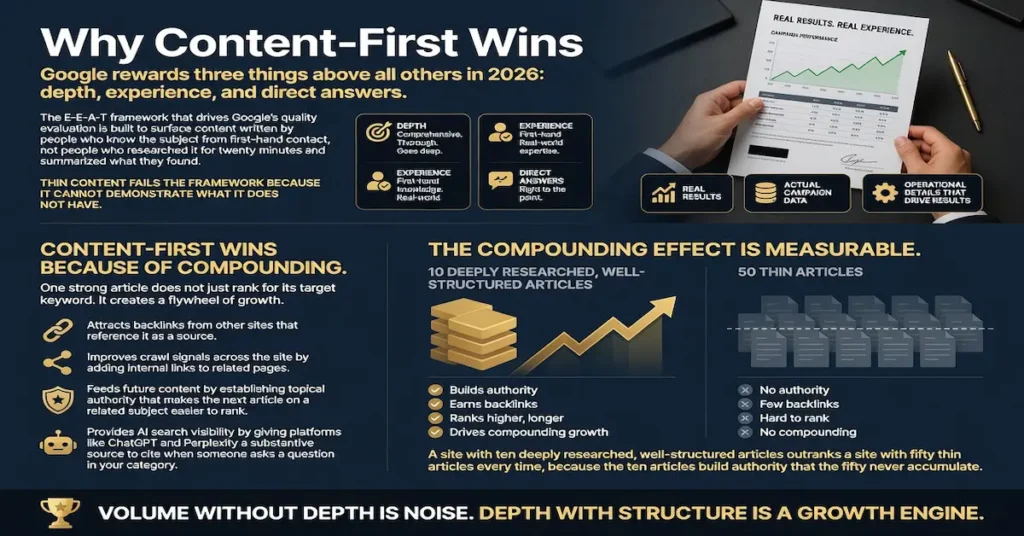
Google rewards three things above all others in 2026: depth, experience, and direct answers. The E-E-A-T framework that drives Google’s quality evaluation is built to surface content written by people who know the subject from first-hand contact, not people who researched it for twenty minutes and summarized what they found. Thin content fails the framework because it cannot demonstrate what it does not have. No screenshots of real results. No data from actual campaigns. No operational details that only someone who has done the work would know to include.
Content-first wins because of compounding. One strong article does not just rank for its target keyword. It attracts backlinks from other sites that reference it as a source. It improves crawl signals across the site by adding internal links to related pages. It feeds future content by establishing topical authority that makes the next article on a related subject easier to rank. And in 2026, it provides AI search visibility by giving platforms like ChatGPT and Perplexity a substantive source to cite when someone asks a question in your category.
The compounding effect is measurable. A site with ten deeply researched, well-structured articles outranks a site with fifty thin articles every time, because the ten articles build authority that the fifty never accumulate. Volume without depth is noise. Depth with structure is a growth engine.
How We Build Content That Ranks
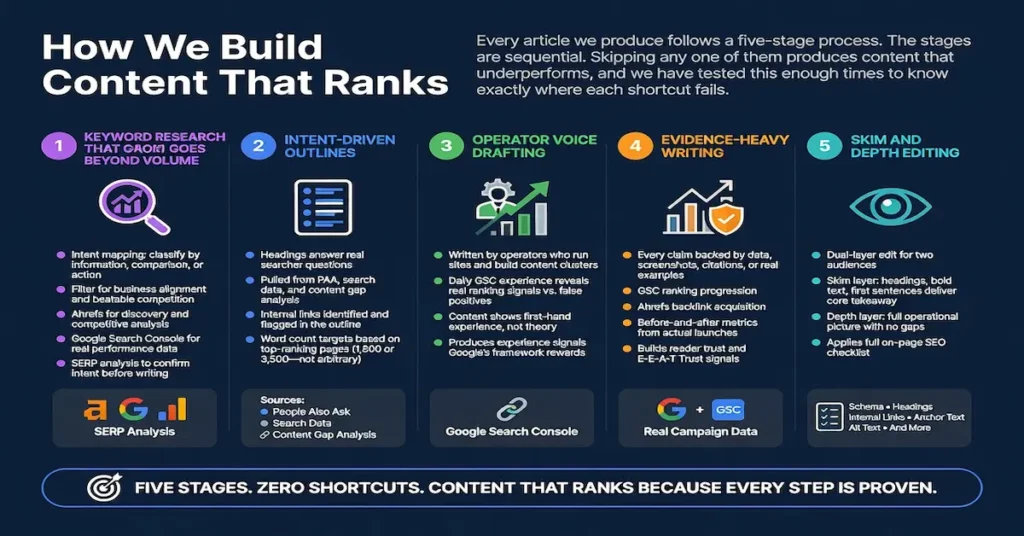
Every article we produce follows a five-stage process. The stages are sequential. Skipping any one of them produces content that underperforms, and we have tested this enough times to know exactly where each shortcut fails.
Stage 1: Keyword Research That Goes Beyond Volume
We do not pick keywords based on search volume alone. Volume tells you how many people search for a term. It tells you nothing about whether those people are your buyers, whether you can compete for that term, or whether the intent behind the query matches what your business offers. Our keyword research starts with intent mapping: classifying every keyword by what the searcher actually wants (information, comparison, or action), then filtering for the terms where the intent aligns with your business and the competition is beatable with the authority your site currently has. We use Ahrefs for keyword discovery and competitive analysis, Google Search Console for real performance data, and SERP analysis to verify that Google agrees with our intent classification before a single word gets written.
Stage 2: Intent-Driven Outlines
Every outline maps to the questions the searcher is actually asking. Headings are not organizational labels. They are answers to specific questions pulled from search data, People Also Ask boxes, and competitor gap analysis. Internal links are identified and flagged during the outline stage, not added as an afterthought during editing. Word count targets are set based on what the top-ranking pages cover, not based on an arbitrary minimum. If the topic requires 3,500 words to cover comprehensively, the outline reflects that. If it requires 1,800, we do not pad to 3,000.
Stage 3: Operator Voice Drafting
Our content is written by people who run sites, not copywriters filling briefs. The difference shows up in the details. An operator who has built and ranked content clusters knows which tactics actually move rankings and which ones sound good in a blog post but produce nothing in practice. An operator who has watched Google Search Console data daily for months knows what early ranking signals look like and what false positives look like. That operational knowledge produces content with the experience signals that Google’s framework specifically rewards. You cannot fake first-hand knowledge in writing. The details betray the writer. Our writers have the details because they have done the work.
Stage 4: Evidence-Heavy Writing
Claims without evidence are opinions. Opinions do not rank. Every substantive claim in our content is supported by data, screenshots, source citations, or direct examples from real campaigns. Google Search Console data showing ranking progression. Ahrefs screenshots showing backlink acquisition. Before-and-after metrics from actual site launches. The evidence serves two purposes: it builds reader trust because the proof is visible, and it builds Google trust because the Trust signals in the E-E-A-T framework specifically evaluate whether content demonstrates its claims rather than merely asserting them.
Stage 5: Skim and Depth Editing
Every article goes through a dual-layer edit. The skim layer ensures that a reader who scans the headings, bold text, and first sentences of each paragraph walks away with the core takeaway without reading the full article. The depth layer ensures that a reader who reads every paragraph gets the complete operational picture with no gaps. Both audiences exist. Both deserve to be served. The edit also applies the full on-page SEO checklist: schema markup, heading hierarchy, internal link verification, anchor text review, and image alt text. Nothing publishes until both layers pass.
The Cluster Architecture
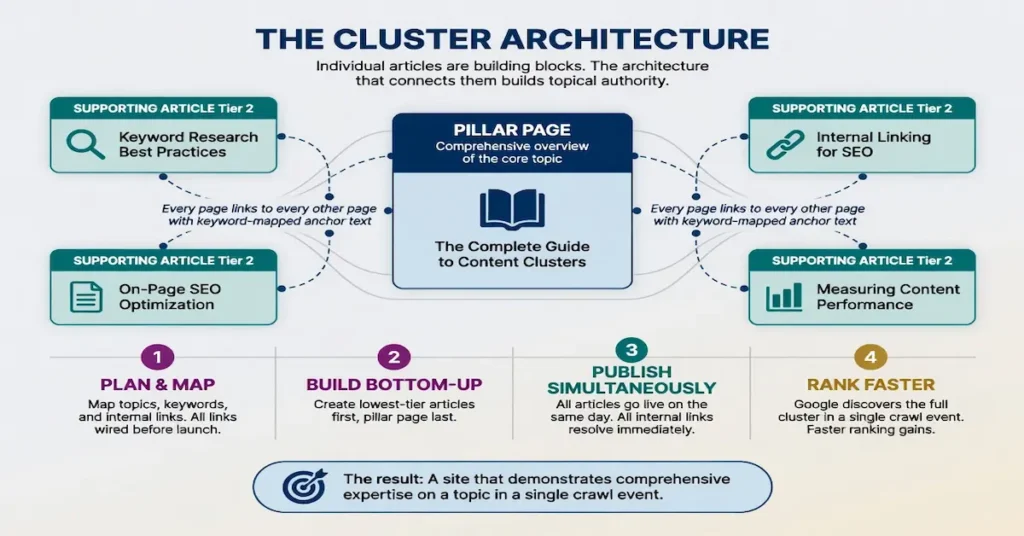
Individual articles are building blocks. The architecture that connects them is what builds topical authority. Every article we produce is part of a content cluster: a group of pages organized around a single topic, connected through deliberate internal linking, and published as a unit.
One pillar page covers the topic comprehensively. Supporting articles go deeper on subtopics. Every page links to every other page in the cluster through carefully chosen keyword-mapped anchor text. When Google crawls one page, it follows the links and discovers the entire cluster. The result is a site that demonstrates comprehensive expertise on a topic in a single crawl event.
We publish clusters simultaneously. Every article goes live on the same day so all internal links resolve immediately. Bottom-up: lowest-tier articles first, pillar last. All links wired before anything goes live. This approach produces faster ranking gains than drip-publishing individual articles because Google sees the full topical depth from the moment it discovers the first page.
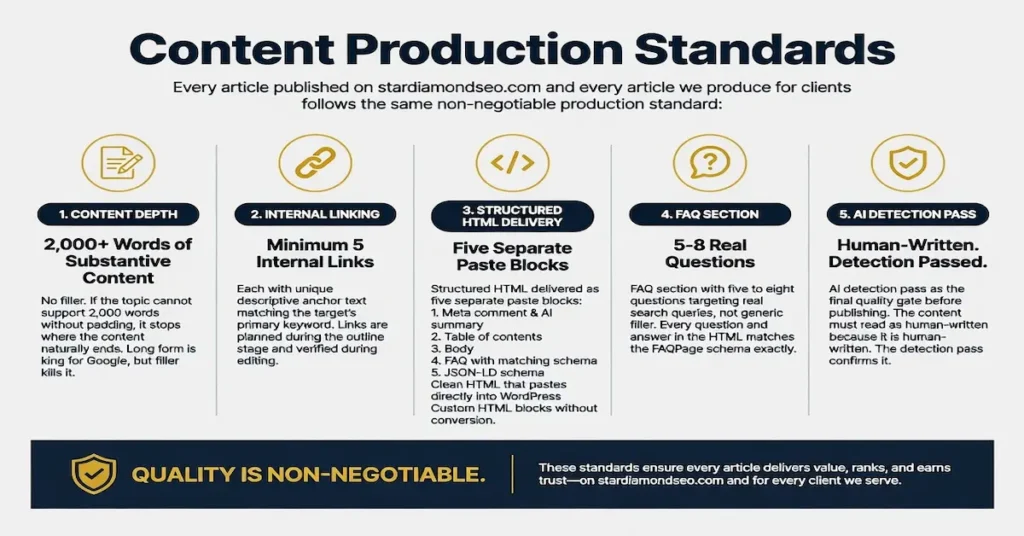
Content Production Standards
Every article published on stardiamondseo.com and every article we produce for clients follows the same non-negotiable production standard:
2,000+ words of substantive content. No filler. If the topic cannot support 2,000 words without padding, it stops where the content naturally ends. Long form is king for Google, but filler kills it.
Minimum five internal links per article, each with unique descriptive anchor text matching the target page’s primary keyword. Links are planned during the outline stage and verified during editing.
Structured HTML delivered as five separate paste blocks: meta comment and AI summary, table of contents, body, FAQ with matching schema, and JSON-LD schema. Clean HTML that pastes directly into WordPress Custom HTML blocks without conversion.
FAQ section with five to eight questions targeting real search queries, not generic filler. Every question and answer in the HTML matches the FAQPage schema exactly.
AI detection pass as the final quality gate before publishing. The content must read as human-written because it is human-written. The detection pass confirms it.
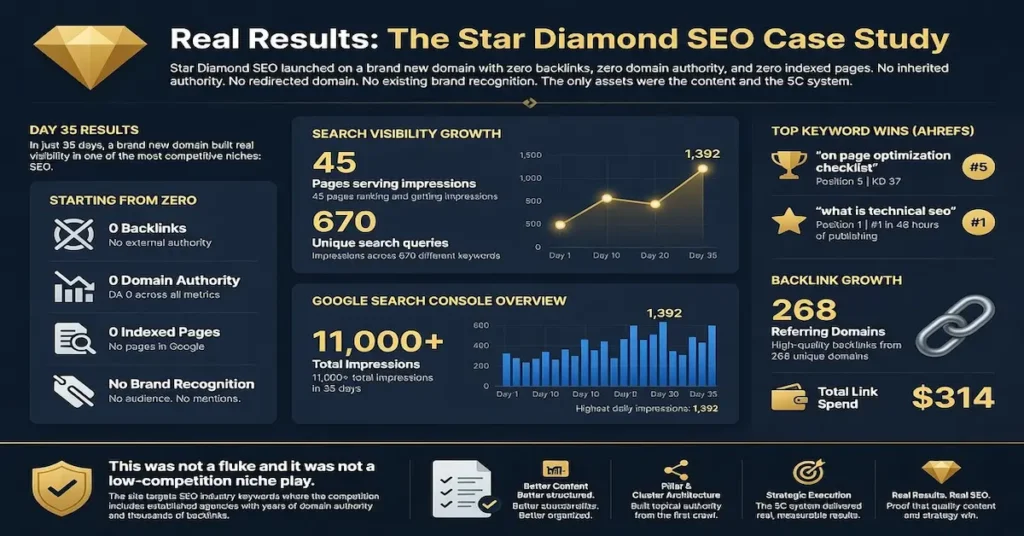
Real Results: The Star Diamond SEO Case Study
Star Diamond SEO launched on a brand new domain with zero backlinks, zero domain authority, and zero indexed pages. No inherited authority. No redirected domain. No existing brand recognition. The only assets were the content and the 5C system.
Within 35 days, the site had 45 pages serving impressions across 670 unique search queries. Google Search Console showed over 11,000 total impressions with daily counts reaching 1,392 in a single day. Thirteen keywords ranked in Ahrefs including a position 5 ranking on “on page optimization checklist” (KD 37) and a position 1 ranking on “what is technical seo” within 48 hours of publishing. 268 referring domains built for a total link spend of $314.
This was not a fluke and it was not a low-competition niche play. The site targets SEO industry keywords where the competition includes established agencies with years of domain authority and thousands of backlinks. The content won because it was better. Better structured. Better sourced. Better organized into pillar and cluster architecture that demonstrated topical authority from the first crawl.
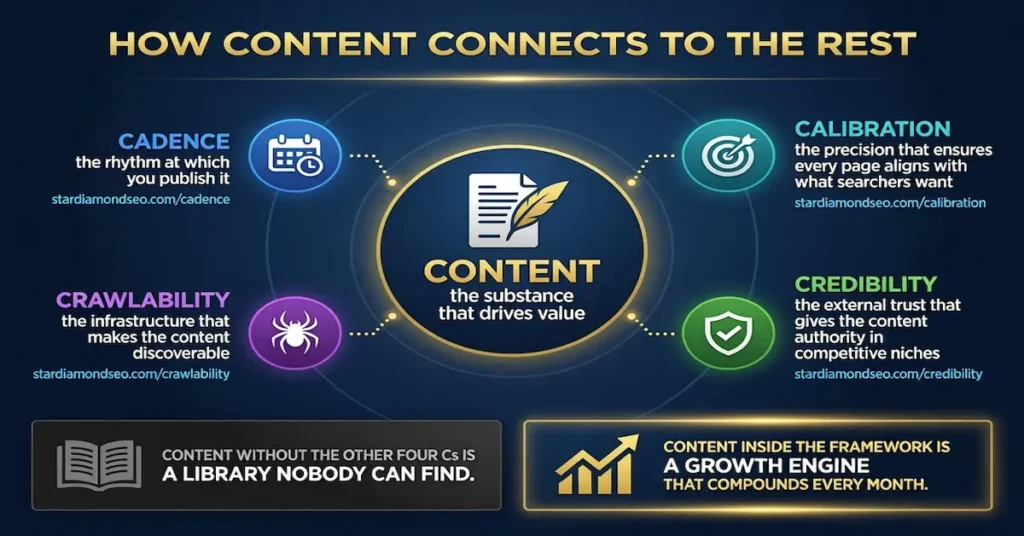
How Content Connects to the Rest
Content is the substance. Cadence is the rhythm at which you publish it. Calibration is the precision that ensures every page aligns with what searchers want. Crawlability is the infrastructure that makes the content discoverable. Credibility is the external trust that gives the content authority in competitive niches.
Content without the other four Cs is a library nobody can find. Content inside the framework is a growth engine that compounds every month.
What We Offer
Our content strategy service handles everything from keyword research and cluster architecture to article production and publishing. Every article follows the five-stage process and meets the production standards described on this page.
For businesses that already have content but are not getting results, we audit existing pages and identify what needs to be rewritten, restructured, or connected to a cluster architecture. Sometimes the content is strong but the writing needs calibration. Sometimes the content is good but the site has crawlability problems preventing it from ranking. The diagnosis determines the fix.
Start with a business consultation to find out whether content is the lever that moves your rankings or whether the real issue is somewhere else in the framework.