
The page has to match what the searcher actually wants.
You can publish a great piece on a consistent schedule and still rank nowhere if the page does not match the search query. Calibration is the alignment layer. It makes sure every page you publish is technically and semantically tuned to what real searchers are looking for.
This is where most agencies fail quietly. They write the content, they hit the publish button, they call the job done. Calibration is the work that happens between drafting and ranking, and skipping it leaves traffic on the table that should have been yours.
What calibration actually means
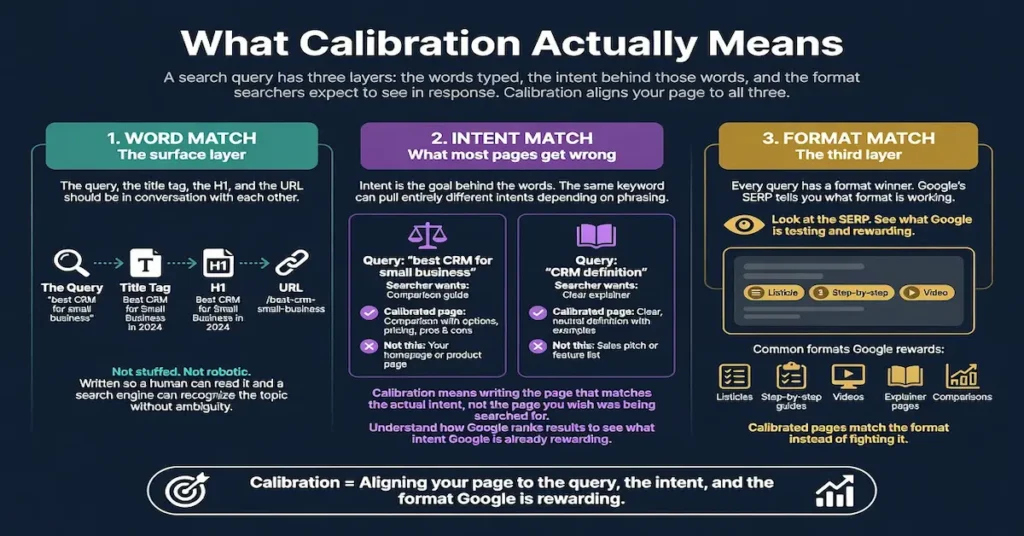
A search query has three layers: the words typed, the intent behind those words, and the format searchers expect to see in response. Calibration aligns your page to all three.
Word match is the surface layer. The query, the title tag, the H1, and the URL should be in conversation with each other. Not stuffed, not exact-matched into a robotic mess. Written so a human can read them and a search engine can recognize the topic without ambiguity.
Intent match is what most pages get wrong. Someone searching “best CRM for small business” wants a comparison guide, not your homepage. Someone searching “CRM definition” wants a clear explainer, not a sales pitch. The same keyword can pull entirely different intents depending on phrasing. Calibration means writing the page that matches the actual intent, not the page you wish was being searched for. Understanding how Google ranks search results makes the intent alignment clearer because you can see what Google is already rewarding for any given query.
Format match is the third layer. Some queries pull listicles. Some pull step-by-step guides. Some pull videos. Google’s SERP for any given query tells you what format is winning. Understanding how Google renders the SERP shows you exactly what format Google is testing for each keyword. Calibrated pages match that format instead of fighting it.
The on-page elements that matter
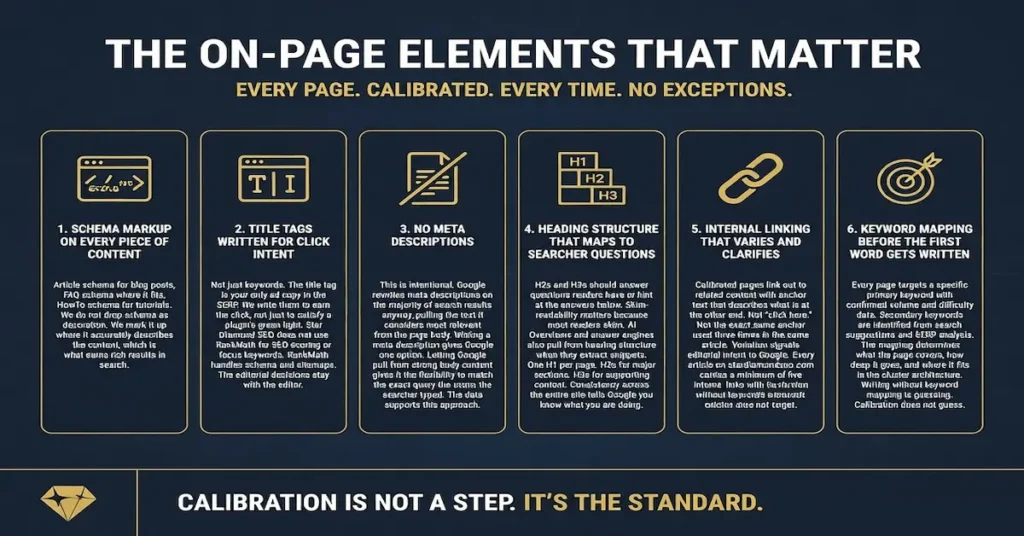
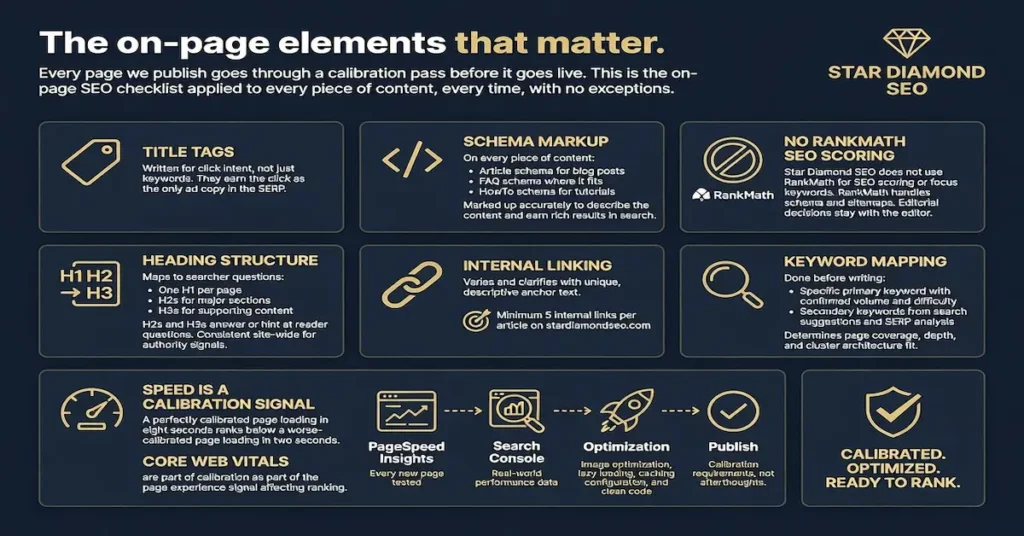
Every page we publish goes through a calibration pass before it goes live. This is the on-page SEO checklist applied to every piece of content, every time, with no exceptions.
Schema markup on every piece of content. Article schema for blog posts, FAQ schema where it fits, HowTo schema for tutorials. We do not drop schema as decoration. We mark it up where it accurately describes the content, which is what earns rich results in search.
Title tags written for click intent. Not just keywords. The title tag is your only ad copy in the SERP. We write them to earn the click, not just to satisfy a plugin’s green light. Star Diamond SEO does not use RankMath for SEO scoring or focus keywords. RankMath handles schema and sitemaps. The editorial decisions stay with the editor.
No meta descriptions. This is intentional. Google rewrites meta descriptions on the majority of search results anyway, pulling the text it considers most relevant from the page body. Writing a meta description gives Google one option. Letting Google pull from strong body content gives it the flexibility to match the exact query the searcher typed. The data supports this approach.
Heading structure that maps to searcher questions. H2s and H3s should answer questions readers have or hint at the answers below. Skim-readability matters because most readers skim. AI Overviews and answer engines also pull from heading structure when they extract snippets. One H1 per page. H2s for major sections. H3s for supporting content. Consistency across the entire site tells Google you know what you are doing.
Internal linking that varies and clarifies. Calibrated pages link out to related content with anchor text that describes what is at the other end. Not “click here.” Not the exact same anchor used three times in the same article. Variation signals editorial intent to Google. Every article on stardiamondseo.com carries a minimum of five internal links with unique, descriptive anchor text for each target.
Keyword mapping before the first word gets written. Every page targets a specific primary keyword with confirmed volume and difficulty data. Secondary keywords are identified from search suggestions and SERP analysis. The mapping determines what the page covers, how deep it goes, and where it fits in the cluster architecture. Writing without keyword mapping is guessing. Calibration does not guess.
Speed is a calibration signal
A perfectly calibrated page that takes eight seconds to load is a page that ranks below a worse-calibrated page that loads in two. Core Web Vitals are not a separate optimization. They are part of calibration because Google evaluates them as part of the page experience signal that affects ranking.
We test every new page through PageSpeed Insights and Search Console before publishing. Image optimization, lazy loading, caching configuration, and clean code are not afterthoughts. They are calibration requirements.
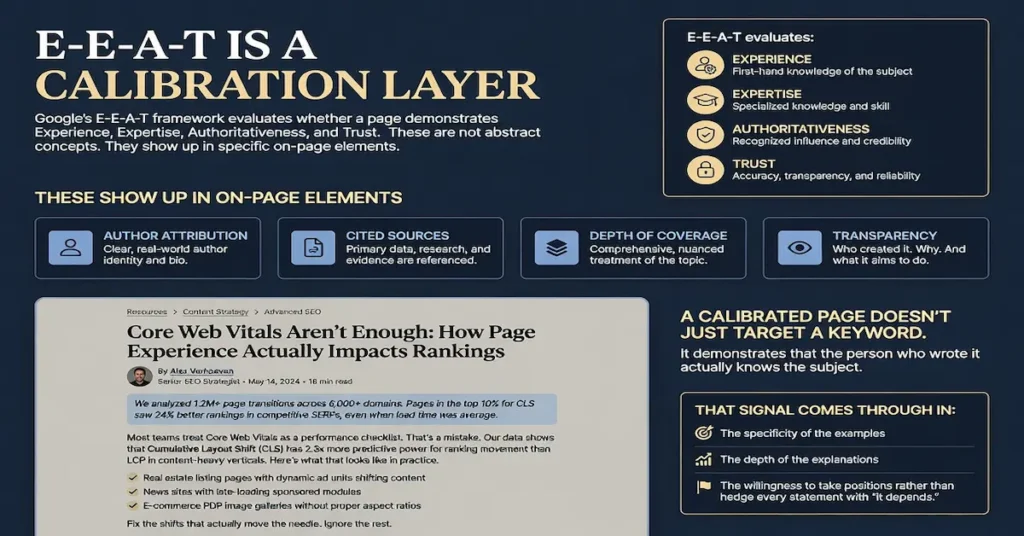
E-E-A-T is a calibration layer
Google’s E-E-A-T framework evaluates whether a page demonstrates Experience, Expertise, Authoritativeness, and Trust. These are not abstract concepts. They show up in specific on-page elements: author attribution, cited sources, depth of coverage, transparency about who created the content and why.
A calibrated page does not just target a keyword. It demonstrates that the person who wrote it actually knows the subject. That signal comes through in the specificity of the examples, the depth of the explanations, and the willingness to take positions rather than hedge every statement with “it depends.”
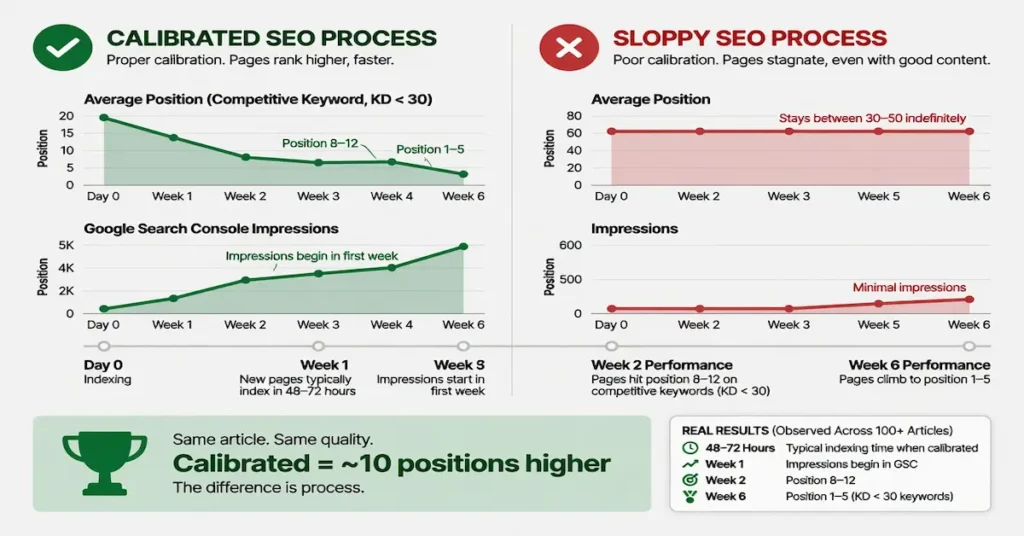
What this looks like in real numbers
When we calibrate properly, new pages typically index within 48 to 72 hours and start showing impressions in GSC within the first week. We have seen pages hit position 8 to 12 in week two and climb to position 1 to 5 by week six on competitive keywords with KD under 30.
When calibration is sloppy, pages sit at position 30 to 50 indefinitely, even if the content is good. The difference is process. The same article, written to the same quality standard, will rank ten positions higher when every calibration element is in place versus when half of them are skipped.
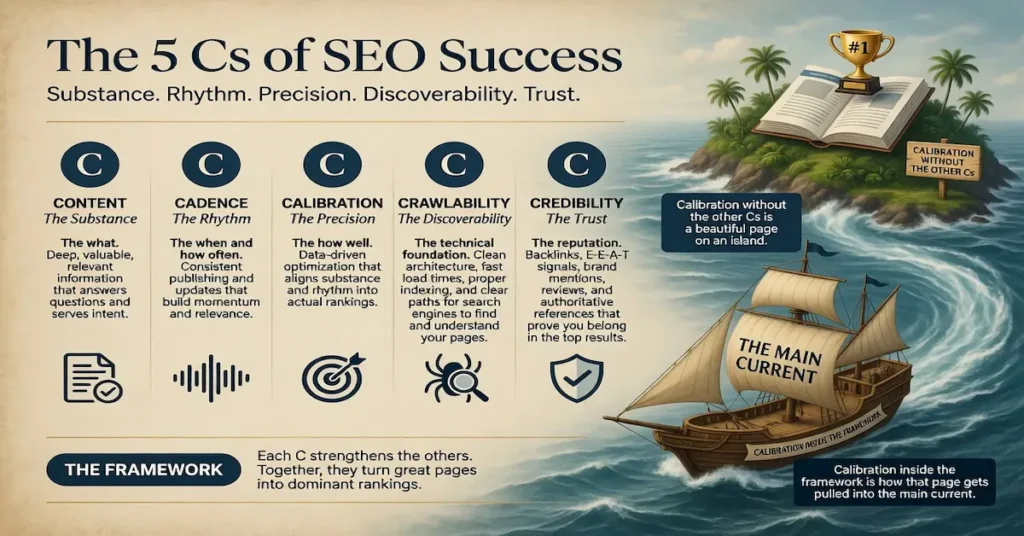
How calibration connects to the rest
Content is the substance. Cadence is the rhythm. Calibration is the precision that turns substance and rhythm into actual rankings.
Calibrated pages still need to be technically discoverable. That is Crawlability. And no matter how well-calibrated a page is, it will struggle in competitive niches without the trust signals that come from Credibility.
Calibration without the other Cs is a beautiful page on an island. Calibration inside the framework is how that page gets pulled into the main current.
What we offer
We calibrate every piece of content we write for clients through our on-page SEO service. For sites that already have content but are not ranking, we offer audit-and-recalibration as a standalone service. We go through existing pages, identify the calibration gaps, and fix them. Often this produces faster ranking gains than writing new content because the foundation is already there.
The content strategy service builds calibration into every article from the keyword mapping stage forward. Nothing gets published without the full calibration pass applied.
Start with a business consultation to find out whether calibration is the gap holding your pages back or whether the problem sits in a different part of the framework.