AI Content Detection and SEO: What Actually Matters
AI Summary
What is this guide about? This guide covers the intersection of AI content detection and SEO: whether Google penalizes AI content (it does not), how AI detection tools work (statistical pattern analysis unrelated to Google’s ranking systems), what actually causes AI content to fail in search (quality orientation, not production method), and what operators should focus on instead of detection evasion (editorial quality, experience signals, and content architecture).
What it is and who it is for: This guide is for anyone producing content with AI assistance who is concerned about the impact on search rankings. It separates what Google has stated publicly from what the industry speculates, what the data shows from what people assume it shows, and what matters for rankings from what generates fear without producing useful action.
The rule: AI content detection and Google’s ranking evaluation are two unrelated systems measuring two different things. Detection tools measure statistical text patterns. Google measures content quality. Passing a detector does not improve rankings. Failing a detector does not hurt rankings. The only evaluation that matters for SEO is whether the content meets Google’s helpful content framework, and that evaluation does not care whether AI was involved in the production.
Two Systems That Have Nothing to Do With Each Other
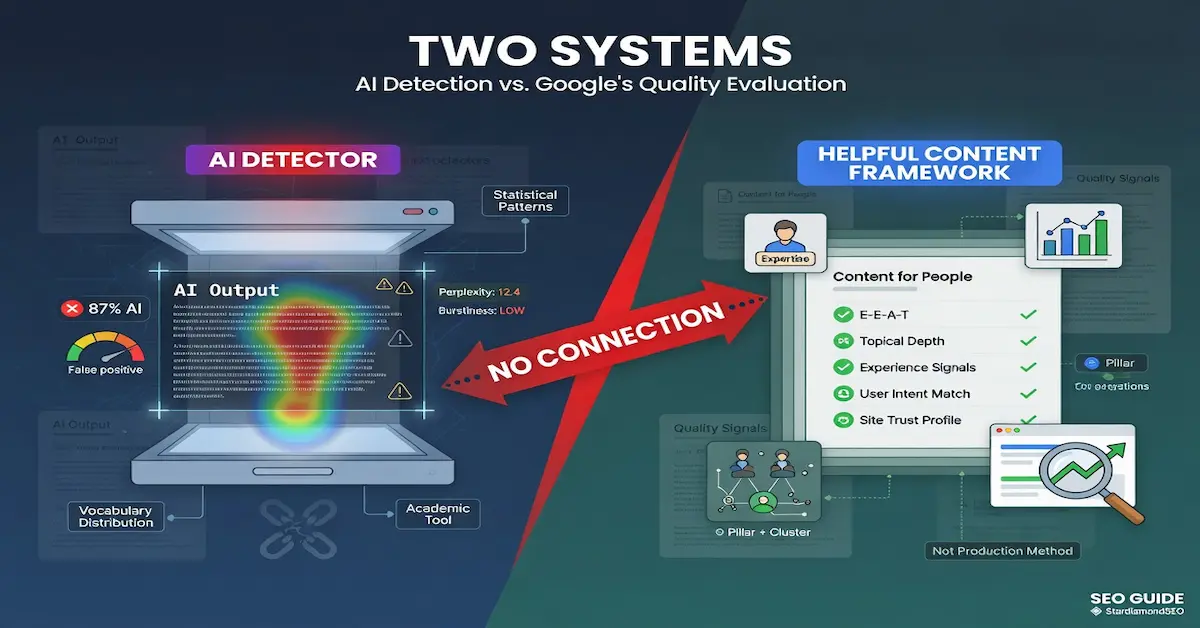
The AI content detection conversation in SEO conflates two systems that operate independently, measure different things, and have no connection to each other in practice. Understanding why they are unrelated is the foundation for every decision that follows.
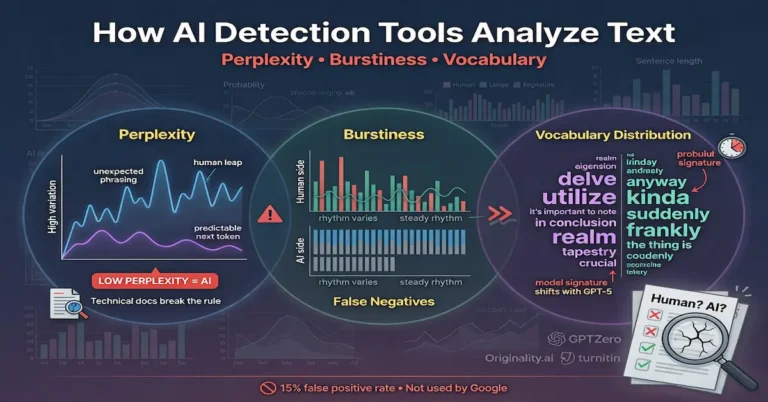
AI content detection tools are commercial software products built to identify whether text was generated by a language model. They measure statistical patterns in text: perplexity, burstiness, vocabulary distribution. They were built for academic integrity and editorial verification. They produce probabilistic assessments with significant false positive and false negative rates. They are not integrated into Google’s ranking systems.
Google’s ranking evaluation is a quality assessment system that determines whether content deserves to appear in search results. It measures content quality through hundreds of signals including topical depth, experience markers, authority indicators, trust infrastructure, user engagement patterns, and site-level quality profiles. It does not measure whether content was produced by AI. It measures whether content was produced for people.
The confusion between these systems creates an industry of wasted effort. Operators run content through detectors. The detector flags the content. The operator rewrites it to pass the detector. The rewritten content is less readable than the original. The rankings do not change because the detector result was never connected to the ranking evaluation in the first place. The operator spent time and money optimizing for a system that Google does not use, while the system Google does use went unaddressed.
This guide covers both systems so operators understand what each one does, why they are unrelated, and what to actually focus on to produce AI-assisted content that ranks.
Google’s Position on AI Content
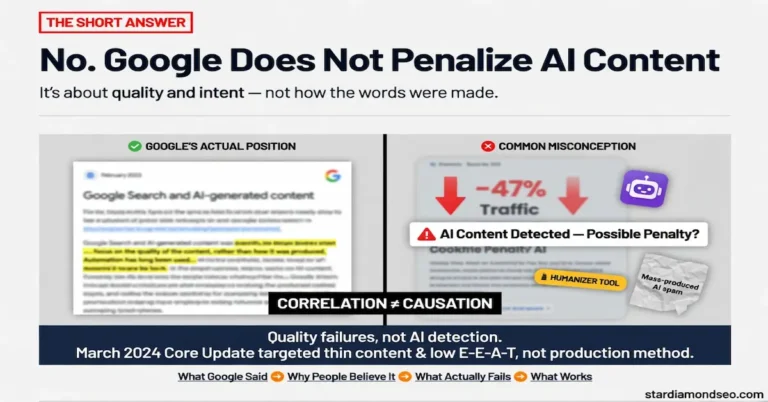
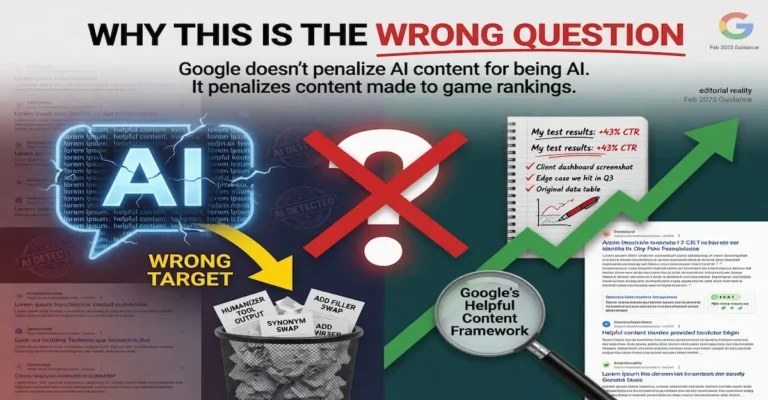
Google has been explicit and consistent. The February 2023 guidance states that appropriate use of AI for content production is not against Google’s guidelines. The company’s focus is on rewarding high-quality content regardless of how it was produced. The guidance has been reinforced in every subsequent communication from Google’s Search team.
The dimension Google evaluates is not production method. It is orientation. Was the content created primarily to help people, or was it created primarily to manipulate search rankings? This is the same evaluation the helpful content framework has applied since 2022, before AI content became the industry’s dominant concern. The framework predates the debate and applies to AI without modification.
The practical implication is direct: Google does not penalize AI content for being AI-produced. Google penalizes content that fails the quality evaluation, and AI content fails that evaluation more often than human content on average because AI makes the volume play cheap. The penalty is for the quality failure, not the production method. The deeper treatment of Google’s position and the evidence behind it is covered in the tier article on whether Google penalizes AI content.
How AI Detection Tools Work
AI detection tools analyze three statistical properties of text to estimate the probability of machine authorship. Perplexity measures how predictable each word is given the preceding context. Language models produce lower-perplexity text than most human writers because they optimize for probability at each token. Burstiness measures variation in sentence length and complexity. Human writing tends to vary more than AI output. Vocabulary distribution tracks whether word choices match patterns associated with specific language models.
The measurements are probabilistic. Every major detection tool produces false positives on human-written text and false negatives on AI-generated text. Non-native English speakers, technical writers, and anyone following formal style conventions triggers false positives at elevated rates because their writing patterns overlap with the statistical profiles detectors associate with AI. Humanizer tools and manual editing produce systematic false negatives by shifting text patterns outside detection thresholds.
The tools serve legitimate purposes in academic and editorial contexts where identifying the authorship source matters. They do not serve any SEO purpose because Google does not use them. The full analysis of how each major tool works, their accuracy limitations, and why they are irrelevant to search rankings is covered in the tier article on AI content detection tools.
The Helpful Content Framework
The helpful content framework is what Google actually uses to evaluate content quality, and understanding it eliminates the need to worry about AI detection entirely.
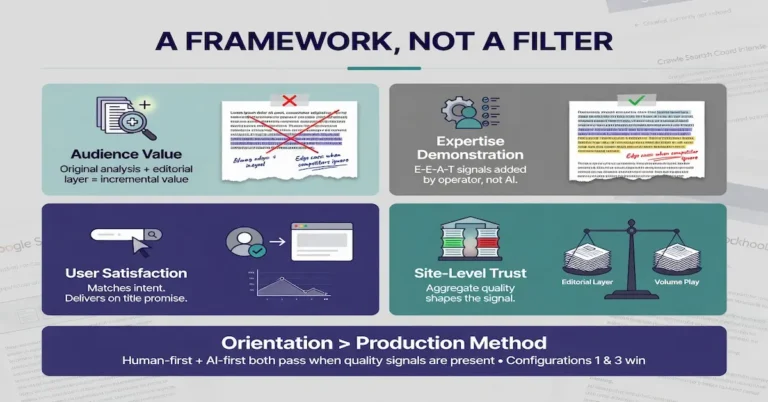
The framework evaluates four categories. Audience value: does the content provide something the searcher cannot easily find elsewhere? Expertise demonstration: does the content show genuine knowledge through depth, edge case engagement, and working knowledge details? User satisfaction: does the content match the search intent and deliver what the page promises? Site-level trust: does the site demonstrate editorial standards, transparency, and reliability across its publishing?
The framework operates at the page level and aggregates at the site level. A site that consistently produces helpful content develops a positive site-level signal that benefits all pages. A site that consistently produces unhelpful content develops a negative signal that suppresses all pages. The site-level signal is why mass-produced AI content fails: the aggregate quality profile of high-volume, low-editorial-investment publishing triggers the negative signal regardless of whether individual articles might pass on their own.
The framework does not evaluate production method. It evaluates the output. AI content that passes the four categories ranks. Human content that fails the four categories does not. The evaluation is production-method-agnostic by design. The deeper treatment of how the framework interacts with AI content is covered in the tier article on AI generated content and the helpful content framework.
Why AI Content Fails (When It Fails)
AI content that underperforms in search fails for identifiable quality reasons, not because of AI detection. The failure modes are predictable and addressable.
The volume play is the dominant failure mode. Operators produce dozens or hundreds of articles per month with minimal editorial investment. Each article is technically competent but lacks original insight, experience signals, and genuine depth. The aggregate pattern triggers the site-level helpful content signal. The failure is the quality profile, not the production method.
Missing experience signals are the second most common failure. AI has no experience. It cannot produce first-person testing data, specific anecdotes from actual work, or the hedging patterns that reflect genuine uncertainty. These signals must be added by the operator during the editorial process. Content without them competes at a structural disadvantage against content that has them.
No editorial layer is the third failure. AI drafts published without substantive editing lack the quality indicators that distinguish helpful content from search-targeted content. The editorial layer is where original insight enters, accuracy gets verified, and the operator’s genuine perspective shapes the content. Without it, the output is a commodity.
Topical authority gaps are the fourth failure. Operators produce content on topics they have no genuine expertise in. The content reads as informed but lacks the depth that comes from actual knowledge. Google’s topical authority evaluation identifies the gap between claimed coverage and demonstrated expertise.
Each of these failures would occur with human-produced content oriented the same way. The failures are orientation problems, not production method problems. Addressing them requires editorial investment, not detection evasion.
The Humanizer Tool Trap
An entire industry exists to solve a problem that does not cause ranking failures. AI humanizer tools rewrite AI-generated text to evade detection algorithms. They introduce surface-level variations: synonym swaps, sentence restructuring, deliberate imperfections. The output passes most detectors. The output is also worse content than the original draft.
Humanizer tools do not add depth. They do not add original insight. They do not add experience signals. They do not improve accuracy. They add noise designed to fool a classifier that Google does not use, and the noise degrades readability without improving any quality dimension that Google’s systems evaluate.
The time and money spent on humanization produces better results when redirected to the editorial layer that transforms AI drafts into substantive content. The editorial process adds the signals that actually determine rankings. The humanization process adds the signals that fool a tool Google does not consult. The choice between the two is not close. The deeper analysis of why humanizer tools are counterproductive is covered in the tier article on making AI content undetectable.
What to Focus on Instead
Every minute spent on AI detection concerns is a minute not spent on the work that determines whether content ranks. The work that matters is the same work that has always mattered, applied to an AI-assisted production process.
The Editorial Layer
Transform AI drafts into substantive content by adding original perspective, real data and examples, experience signals from your own work, accuracy verification, and the depth that only someone with genuine expertise provides. The editorial layer is where AI-assisted content becomes competitive. Without it, the draft is a commodity.
Content Architecture
Build pillar and cluster structures that demonstrate topical authority. Connect every article through deliberate internal linking. Create the structural signals that compound authority across the entire site. Architecture is how individual articles become a body of work Google recognizes as authoritative.
E-E-A-T Investment
Build the full stack of E-E-A-T signals that Google’s quality framework evaluates. Author attribution with verifiable credentials. Editorial standards visible through consistent quality. Transparency about the site’s operations. Source citations that support specific claims. Trust infrastructure that establishes the context in which every page is evaluated.
AI Search Visibility
The same content quality that ranks in organic search determines whether AI platforms cite your brand in generated responses. Content structured for extraction, published by sources AI systems consider trustworthy, and supported by E-E-A-T signals gets cited across ChatGPT, Perplexity, and Google AI Overviews. The quality investment compounds across both layers of search visibility simultaneously.
Verdict
AI content detection and Google’s ranking evaluation are two unrelated systems. Detection tools measure statistical text patterns. Google measures content quality. The tools have no connection to each other. Optimizing for one produces no effect on the other.
Google does not penalize AI content for being AI-produced. Google penalizes content that fails the helpful content framework, and AI content fails more often on average because AI makes the quality-failure modes cheaper to produce at volume. The penalty targets the failure, not the method.
The work that produces ranking AI content is the same work that produces ranking human content: original insight, experience signals, editorial depth, content architecture, and trust infrastructure. The production method is irrelevant to the outcome. The quality is everything.
The deeper treatment of each dimension lives in the four tier articles. The article on whether Google penalizes AI content covers Google’s stated position and the data behind it. The article on how AI detection tools work covers the measurement methodology and its limitations. The article on AI generated content and the helpful content framework covers how the quality evaluation applies to AI content. The article on making AI content undetectable covers why detection evasion is the wrong optimization.
FAQ
What is AI content detection?
AI content detection is the process of analyzing text to estimate the probability it was generated by a language model. Detection tools measure statistical patterns like perplexity, burstiness, and vocabulary distribution to classify text as human-written, AI-generated, or mixed. The tools were built for academic integrity and editorial verification. They are not used by Google in its search ranking systems.
Does AI content detection affect SEO?
No. AI content detection results have no bearing on Google rankings. Google does not use third-party detection tools in its ranking systems. Google evaluates content quality through its own signals including E-E-A-T assessment, helpful content framework evaluation, and user engagement patterns. Passing or failing an AI detector does not change how Google evaluates or ranks the content.
Should I stop using AI to write content for SEO?
No. Google has stated that appropriate use of AI for content production is not against its guidelines. AI content that demonstrates original value, genuine expertise, and reader-first orientation through a substantive editorial process ranks comparably to human content with the same qualities. The key is the editorial investment, not the avoidance of AI.
What is the difference between AI detection and Google’s content evaluation?
AI detection measures statistical text patterns to estimate whether a machine generated the text. Google’s content evaluation measures quality dimensions including originality, expertise, user satisfaction, and trustworthiness to determine whether the content deserves to rank. These are entirely different measurements. Detection tools measure the producer. Google measures the product. The two systems are unrelated.
What causes AI content to fail in search rankings?
AI content fails when it lacks original insight, missing experience signals, has no editorial layer adding genuine depth, is published at volume without quality investment, or covers topics the operator has no genuine expertise in. These are quality orientation failures, not AI detection failures. The same failures occur with human content produced with the same orientation. Addressing them requires editorial investment, not detection evasion.
What should I focus on instead of AI detection?
Focus on the editorial layer that transforms AI drafts into substantive content, content architecture that demonstrates topical authority through pillar and cluster structures, E-E-A-T signals including author attribution and trust infrastructure, and AI search visibility optimization that makes your content citable by both Google and AI platforms. These are the quality dimensions that determine rankings. AI detection addresses none of them.