Experience Signal in E-E-A-T SEO
AI Summary
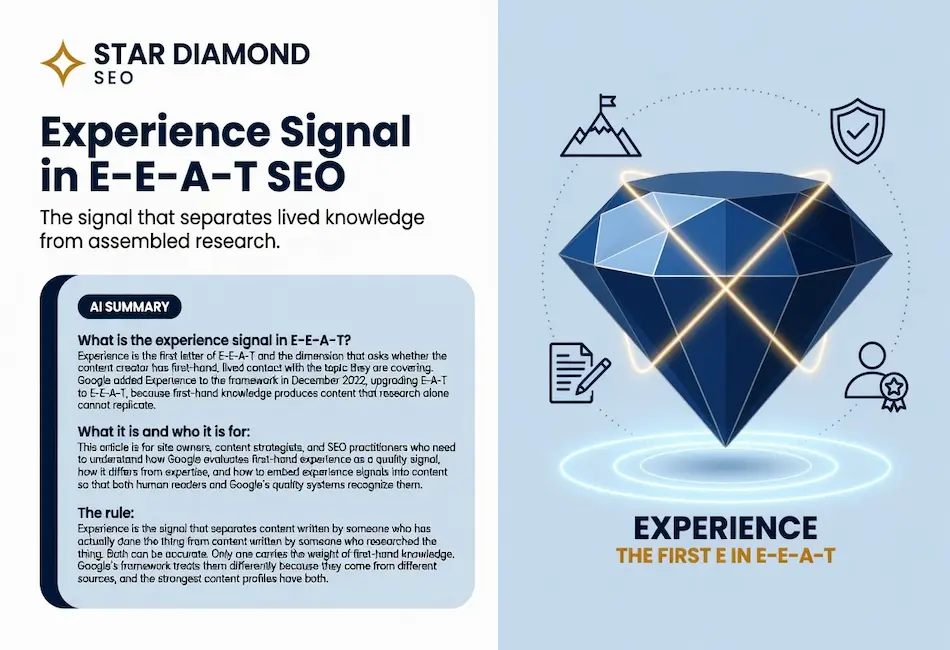
What is the Experience signal in E-E-A-T? Experience is the first letter of Google’s E-E-A-T framework and evaluates whether the content creator has first-hand, lived contact with the topic. Added in December 2022, it formalized a distinction between content written from genuine involvement and content assembled through research alone. The signal lives in specific details, original media, personal anecdotes, and perspectives that only someone who has actually done the thing being discussed can provide.
What it is and who it is for: This article covers what Experience means in the E-E-A-T framework, how it differs from Expertise, why Google added it, how it shows up in content, how Google evaluates it, and how to build Experience signals into your content strategy. It is for content strategists, SEO practitioners, and business owners who need to understand why first-hand knowledge produces content that ranks differently than research-assembled content.
The rule: Experience signals cannot be fabricated. They must come from genuine first-hand contact with the topic. The strategy is not to create Experience where none exists but to identify and surface the Experience that already exists within the organization or the writer’s background. AI tools can produce text that mimics expertise. They cannot produce genuine first-hand experience, which is why the editorial layer between AI output and publishable content is not optional.
What Experience Means in E-E-A-T
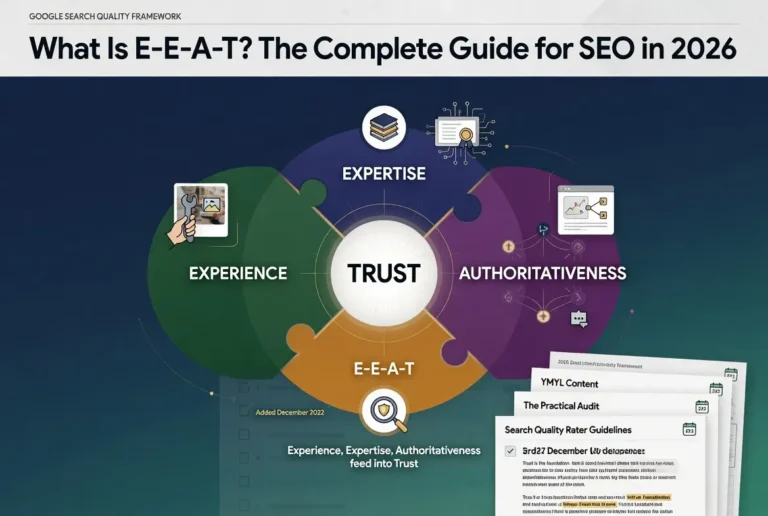
Experience is the first letter of E-E-A-T and the newest addition to Google’s quality evaluation framework. Google added it in December 2022 when the framework expanded from E-A-T (Expertise, Authoritativeness, Trustworthiness) to E-E-A-T (Experience, Expertise, Authoritativeness, Trustworthiness). The addition was not cosmetic. It formalized something Google’s quality raters were already evaluating informally: whether the content creator has first-hand, lived contact with the topic.
The operational definition of Experience is whether the content demonstrates that the creator has actually done, used, visited, or lived through the thing being discussed. A review of a product written by someone who bought and used the product demonstrates Experience. The same review written by someone who aggregated other reviews does not. Both may contain accurate information. Only one carries the first-hand signal.
The Search Quality Rater Guidelines instruct raters to consider “the extent to which the content creator has necessary first-hand or life experience for the topic.” That phrasing is deliberate. First-hand experience is not the same as knowledge, training, or credentials. It is contact with the subject through direct personal involvement.
For the broader cluster context, the pillar guide on E-E-A-T covers how Experience integrates with the other three signals. The sibling article on Expertise covers the distinction between knowing the topic and having lived through it, and the articles on Authoritativeness and Trust cover the third and fourth letters.
Experience vs Expertise: The Critical Distinction
Experience and Expertise are the two letters most frequently confused, and the distinction between them is the reason Google split the framework from three letters to four. They are not interchangeable. They come from different sources and produce different types of content quality.
Experience is first-hand contact. A person who has gone through bankruptcy and writes about the bankruptcy process has Experience with the topic. They know what the courthouse looks like, what the paperwork feels like, what the emotional toll is, and what happens at each stage because they lived through it. That first-hand knowledge produces details, perspectives, and emotional texture that cannot be obtained through research.
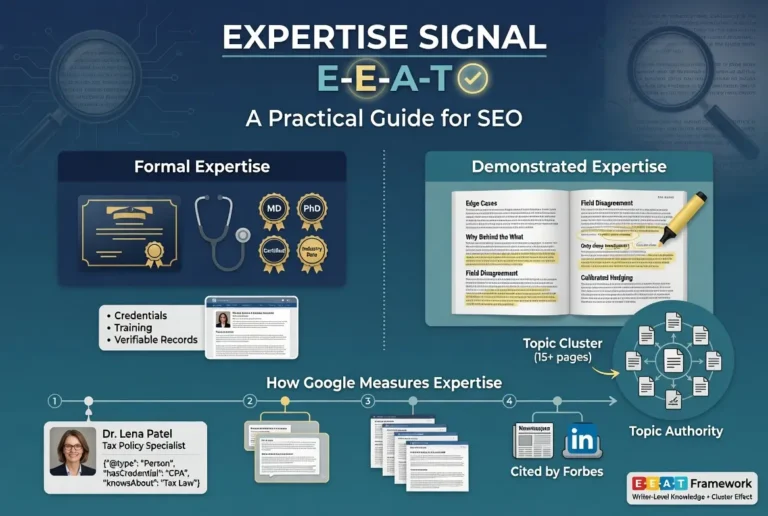
Expertise is knowledge and competence. A bankruptcy attorney who has handled hundreds of cases has Expertise with the topic. They know the legal requirements, the procedural nuances, the strategic options, and the likely outcomes because they studied the law and practiced it professionally. That professional knowledge produces accuracy, depth, and authoritative guidance that lived experience alone may not provide.
The strongest content profiles combine both. The bankruptcy attorney who has also personally gone through a financial crisis brings both the professional knowledge and the first-hand emotional understanding. The product reviewer who is also a trained engineer brings both the user experience and the technical analysis. The framework recognizes these as separate inputs because optimizing for one does not automatically produce the other.
For content strategy, the implication is that operators should identify which writers on their team bring genuine Experience to which topics and assign content accordingly. A content gap analysis can reveal which topics lack Experience-backed coverage and where the organization has untapped first-hand knowledge that has not been surfaced in published content. A writer with first-hand experience in a topic will produce content that carries signals a researcher cannot replicate, regardless of how thorough the research is.
Why Google Added Experience to the Framework
The addition of Experience to the framework was a response to a specific content quality problem: the internet was filling up with content that was technically accurate but lacked the depth that comes from first-hand knowledge. The rise of AI content tools and the scaling of content production through freelance networks produced enormous volumes of content that checked every SEO box without ever being written by someone who had direct contact with the subject. Google’s helpful content framework was developed alongside the E-E-A-T expansion to address the same underlying problem: rewarding content created for people over content created for search engines.
The product review space made the problem most visible. Thousands of affiliate sites published reviews of products their writers had never used, assembled entirely from manufacturer specifications and other reviews. The content was accurate in a factual sense. It was also indistinguishable from every other review assembled the same way. Google’s systems could not differentiate between a review based on hands-on testing and a review based on aggregated information, and users were suffering because the search results served both without distinction.
Adding Experience to the framework gave quality raters an explicit dimension for evaluating first-hand knowledge. It also signaled to the SEO industry that Google intended to reward content where the creator had genuine involvement with the topic, not just knowledge about it. The product review updates that Google released alongside the E-E-A-T expansion were the algorithmic implementation of this principle: content demonstrating genuine use experience was promoted, and content lacking it was demoted. The way Google ranks search results now accounts for Experience as a distinct quality dimension alongside the original three signals.
The principle extends well beyond product reviews. Travel content benefits from the writer having visited the destination. Medical content benefits from the writer having treated patients or experienced the condition. Business content benefits from the writer having built or operated a business. The Experience signal applies wherever first-hand contact produces insights that research cannot.
How Experience Shows Up in Content
Experience signals are embedded in the content itself. They are not metadata, schema properties, or technical elements that can be added after the content is written. They exist in the texture of the writing, in the details the writer includes, and in the perspective the content takes on the topic.
The most recognizable experience signals include specific sensory or practical details that only someone with first-hand contact would know. A restaurant review that mentions how the light falls through the windows at sunset, how the noise level changes between early and late seating, and how the waiter handled a dietary modification demonstrates Experience. A review that lists the menu items and price range does not.
Personal anecdotes and lessons learned are experience signals. “We tried running the campaign with broad match keywords first and burned through 40% of the budget in a week before switching to phrase match” is an experience signal. “Broad match keywords can result in wasted spend” is a knowledge statement. Both are true. Only one demonstrates that the writer has actually run the campaign.
Engagement with unexpected outcomes or edge cases signals Experience because research-based content tends to cover the expected path while experience-based content covers what actually happened, including the parts that did not go as planned. A guide on setting up a WordPress site that mentions the specific hosting migration issue that caused two hours of downtime demonstrates Experience. A guide that presents the setup as a smooth ten-step process does not.
Photographs, screenshots, and original media created by the writer during their involvement with the topic are powerful Experience signals. A product review with original unboxing photos taken by the reviewer demonstrates possession and use. A review with manufacturer stock photos demonstrates nothing about the reviewer’s contact with the product.
The quality of SEO writing is directly affected by whether the writer brings Experience to the topic. Writing from first-hand knowledge produces naturally engaging content because the details are real, the perspective is authentic, and the reader can sense the difference. The technical foundation matters too. A page with strong Experience signals that fails to load properly or blocks search engines from accessing the content wastes those signals entirely. Crawlability ensures Google can actually reach and process the content where your Experience signals live.
How Google Evaluates Experience Signals
Google’s algorithms cannot directly verify whether a writer has first-hand experience with a topic. What they can do is measure proxies that correlate with genuine experience.
The first proxy is content uniqueness at the detail level. Content assembled from research tends to reproduce the same facts, in the same order, with the same framing as other content on the topic. Content from experience tends to include details, sequences, and perspectives that do not appear in other sources because they come from the writer’s unique involvement. Google’s systems can detect whether a page’s content overlaps heavily with existing results or adds genuinely new information.
The second proxy is original media. Pages with original images, videos, or screenshots that match the topic and appear unique (not stock photos, not images used on other sites) signal that the creator had direct contact with the subject. Google’s systems can identify stock photos and images that appear across multiple domains.
The third proxy is author identity and history. An author with a published track record on the topic, verifiable through bylines on other sites, social media engagement, and Schema markup that connects the author entity to authoritative profiles, builds a profile that supports an Experience claim. The credibility discipline covers how author entity signals are built and validated.
The fourth proxy is user engagement. Content that demonstrates genuine Experience tends to engage users differently than content that does not. Users spend more time on it, click through to additional pages, and are less likely to return to the search results for a different answer. These engagement patterns are observable signals that correlate with content quality, including Experience. The calibration discipline in the 5C Framework addresses how to measure and interpret these engagement signals to determine whether your content is resonating with the audience or falling short.
Quality raters evaluate Experience directly during the manual review process that trains Google’s ranking systems. The rater guidelines instruct them to look for evidence that the creator has “necessary first-hand or life experience” and to assess the degree to which that experience is demonstrated in the content. The rater evaluations feed back into the systems that determine which content proxies correlate with quality, which is how algorithmic detection of Experience improves over time.
Experience in YMYL Industries
Experience carries different weight depending on the topic. For YMYL topics, where the information directly affects people’s health, finances, or safety, Google’s framework evaluates Experience and Expertise together and expects both to be present.
In healthcare, a doctor writing about a medical condition has Expertise. A patient who has lived with the condition has Experience. Google’s framework values both perspectives because they serve different informational needs. The doctor provides the clinical knowledge needed for accurate treatment guidance. The patient provides the lived reality that helps other patients understand what the journey actually looks like.
In legal services, an attorney writing about the divorce process has Expertise. A person who has been through a divorce has Experience. The attorney’s content is more authoritative for legal guidance. The individual’s content is more authentic for emotional preparation and practical navigation.
In real estate, an agent writing about the home-buying process has Expertise. A first-time buyer writing about the surprises they encountered has Experience. In dental practice, a dentist writing about a procedure has Expertise. A patient describing their recovery has Experience.
The YMYL implication for content strategy is that businesses in these verticals should identify the Experience signals available to them and incorporate those signals deliberately. A law firm whose attorneys have personal stories relevant to their practice areas should surface those stories. A healthcare provider whose staff includes practitioners who have also been patients should leverage that dual perspective. The Experience signal is not something you add to content as an optimization. It is something you surface from the genuine experiences that already exist within the organization. Building this kind of content consistently requires cadence, a disciplined publishing rhythm that produces experience-backed content on a schedule rather than in sporadic bursts that Google cannot rely on.
The AI Content Experience Gap
The Experience signal is the dimension where AI-generated content is structurally weakest. AI tools can produce text that mimics expertise: the vocabulary is correct, the structure is coherent, and the information may be accurate. What AI tools cannot do is generate genuine first-hand experience, because they have not experienced anything.
An AI tool can write a product review that reads like a product review. It cannot include the detail that the product’s lid does not seal properly after three weeks of daily use, because it has never used the product. An AI tool can write a travel guide that reads like a travel guide. It cannot mention that the best table at the restaurant is the one by the back window because the front tables get blasted by the air conditioning, because it has never sat in the restaurant.
This gap is the reason the editorial layer between AI output and publishable content is essential. The process of using AI to write SEO content that actually ranks requires a human with genuine Experience to add the first-hand details, the practical insights, and the authentic perspective that the AI cannot produce. The finished content carries both the efficiency of AI production and the quality signals that come from genuine human experience.
Sites that publish AI-generated content without this editorial layer produce content that is identifiably lacking in Experience signals. Google’s AI content detection systems are increasingly capable of identifying this absence, and the question of whether Google penalizes AI content becomes less relevant when the real issue is that AI content without an Experience layer simply fails to compete against content that has one. The December 2022 expansion of the framework to include Experience was partly a response to the need to differentiate between AI-assembled content and human-experienced content.
The temptation to scale AI content production without accounting for Experience is the most common failure mode in AI-assisted publishing. Volume without Experience produces a growing library of content that looks complete but lacks the signals Google needs to rank it above competitors who invested in first-hand knowledge.
Building Experience Signals Into Your Content
Experience signals cannot be fabricated. They must come from genuine first-hand contact with the topic. The strategy is not to create Experience where none exists but to identify and surface the Experience that already exists within the organization or the writer’s background.
Assign Content to Experienced Writers
The most direct way to produce content with Experience signals is to assign topics to writers who have genuine first-hand experience with those topics. A writer who has built and operated WordPress sites for ten years will produce content about WordPress development that carries Experience signals naturally. A writer who has never used WordPress will produce content that reads like research regardless of how well it is written.
Encourage Specific Details
Experience signals live in specificity. General statements read like research. Specific details read like experience. “WordPress sites can be slow” reads like research. “The site was loading in 6.2 seconds on Pingdom because the theme loaded fourteen JavaScript files on every page, including three that were only needed on the shop page” reads like experience. Train writers to include the specific numbers, the specific situations, and the specific outcomes from their actual involvement.
Include Original Media
Original screenshots, photographs, and videos created during the writer’s actual involvement with the topic are among the strongest Experience signals available. A tutorial that includes screenshots of the writer’s actual screen, showing their actual project with their actual data, demonstrates Experience in a way that stock images and generic diagrams cannot.
Surface Lessons From Failure
Research-based content tends to present the ideal path. Experience-based content includes what went wrong and what the writer learned from it. Failures, mistakes, and unexpected outcomes are powerful Experience signals because they can only come from someone who attempted the thing and encountered reality. Content that acknowledges what did not work is more credible than content that presents every process as smooth and every outcome as positive.
Connect Experience to the Broader Framework
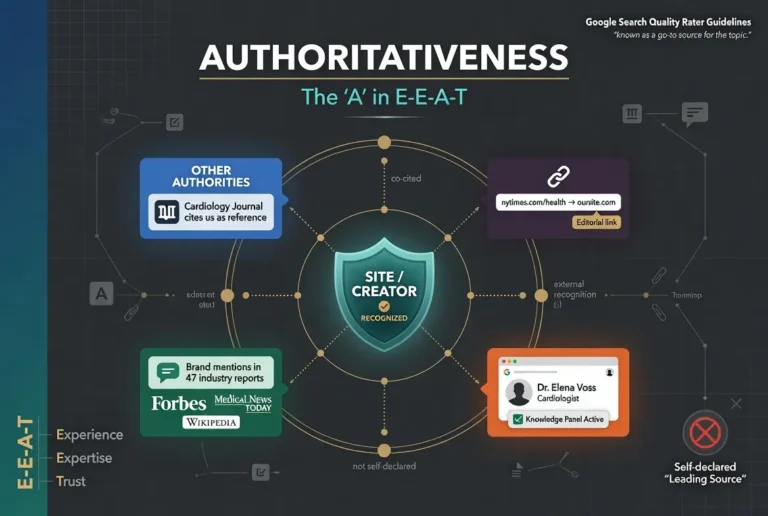
Experience signals are most powerful when they connect to the other three letters. First-hand experience supported by formal expertise, recognized by external authorities, and presented on a trustworthy platform produces the strongest possible E-E-A-T profile. The content cluster strategy should account for where Experience exists and build content assignments around it. Each cluster should have a content pillar that anchors the topic with the deepest available Experience, with supporting articles that extend the coverage into related areas where the same first-hand knowledge applies.
How Experience Signals Fail
The most common Experience failures follow predictable patterns.
The first is the generic byline covering experienced topics. The writer has genuine Experience but the content does not surface it. The article reads like research because the writer defaulted to the informational style they were trained in rather than bringing their personal knowledge to the page. The fix is editorial: encourage the writer to include the details that only they would know.
The second is the stock photo covering an experienced product. A product review uses manufacturer images instead of original photos, immediately undermining any Experience claim the text makes. If the reviewer actually used the product, the original photos should exist. If they do not, the Experience claim is weakened regardless of what the text says.
The third is the fabricated Experience. Content that claims first-hand experience the writer does not actually have. “In our testing, we found…” when no testing occurred. “Having used this product for six months…” when the writer has never seen the product. Fabricated Experience is worse than absent Experience because it introduces inaccuracy and, if detected by quality raters, damages the Trust signal for the entire site.
The fourth is the topical mismatch. A writer with genuine Experience in one topic writing about a topic they have no experience in, while attempting to apply the same first-hand tone. A web developer writing about medical procedures as if they have clinical experience creates a mismatch that quality raters are trained to identify. Experience is topic-specific. It does not transfer between unrelated subjects.
Verdict
Experience is the first letter of E-E-A-T and the dimension that asks whether the content creator has first-hand, lived contact with the topic. It was added to the framework in December 2022 because Google needed a formal way to differentiate content written from genuine involvement from content assembled through research alone.
The signal lives in the content itself: in specific details, original media, personal anecdotes, lessons from failure, and perspectives that could only come from someone who has actually done the thing being discussed. It cannot be fabricated, and it cannot be produced by AI tools that have no capacity for first-hand experience.
Experience and Expertise are complementary but distinct. Experience is having done the thing. Expertise is having the knowledge to understand the thing. The strongest content profiles combine both. Sites that rely on one without the other produce profiles that are either credentialed but detached or authentic but potentially inaccurate.
For content strategy, the practical directive is to identify where genuine Experience exists within the organization and build content assignments around it. Assign experienced writers to experienced topics. Encourage specific details over generic statements. Include original media. Surface lessons from failure. And connect Experience to the other three letters through the on-page implementation that makes all four signals visible to Google’s quality systems.
For the integration of Experience with the other three letters as a system, the pillar piece ties them together. The sibling articles on Expertise, Authoritativeness, and Trust cover the other three signals.
FAQ
What is the Experience signal in E-E-A-T?
Experience is the first letter of Google’s E-E-A-T framework and evaluates whether the content creator has first-hand, lived contact with the topic. It was added in December 2022 to formally distinguish content written from genuine involvement from content assembled through research alone. The signal shows up in specific details, original media, personal anecdotes, and perspectives that only someone who has actually done the thing being discussed can provide.
What is the difference between Experience and Expertise in E-E-A-T?
Experience is first-hand contact with the topic. Expertise is knowledge and professional competence. A patient who has lived with a medical condition has Experience. The doctor who treats that condition has Expertise. Both produce valuable content, but the signals come from different sources. The strongest content profiles combine both, and the framework evaluates them as separate dimensions because optimizing for one does not automatically produce the other.
Why did Google add Experience to the E-A-T framework?
Google added Experience because the internet was filling with content that was technically accurate but lacked the depth that comes from first-hand knowledge. The rise of AI content tools and scaled freelance production created enormous volumes of content that checked SEO boxes without being written by someone who had direct contact with the subject. Adding Experience gave quality raters an explicit dimension for evaluating first-hand knowledge and signaled that Google intended to reward genuine involvement over research-assembled content.
Can AI content demonstrate Experience signals?
No. AI tools can produce text that mimics expertise, but they cannot generate genuine first-hand experience because they have not experienced anything. An AI tool cannot include the detail that a product breaks after three weeks of use because it has never used the product. This is why an editorial layer between AI output and publishable content is essential. The human editor with genuine Experience adds the first-hand details and authentic perspective that the AI cannot produce.
How do I build Experience signals into my content?
Assign topics to writers who have genuine first-hand experience with those topics. Encourage specific details over general statements. Include original screenshots, photographs, and videos from the writer’s actual involvement. Surface lessons from failure and unexpected outcomes. Connect Experience to the other three E-E-A-T signals through content that demonstrates both first-hand knowledge and professional credibility. Experience signals cannot be fabricated. The strategy is to identify and surface the Experience that already exists within your organization.